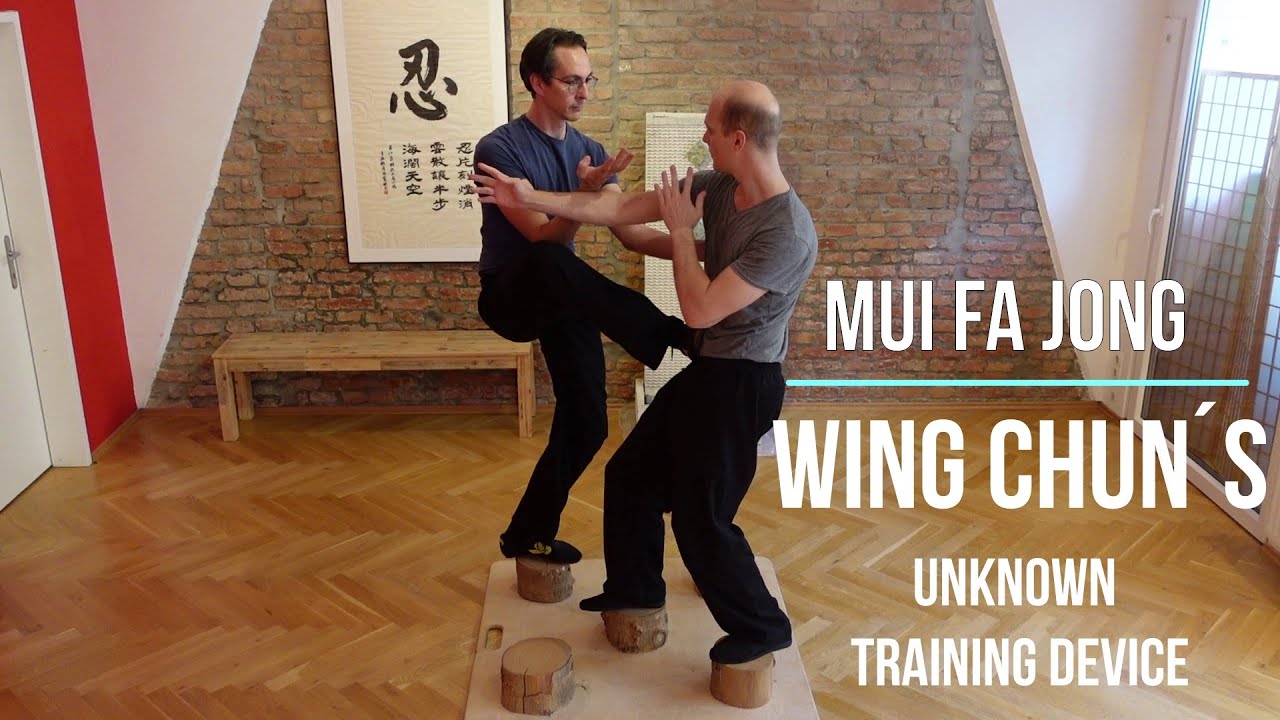
Mui Fa Jong or Plum Flower Poles
The Mui Fa Jong, also known as the Plum Flower Posts or Poles, is an important training tool in Chinese Kung Fu that helps develop footwork, balance, and body positioning. The name comes from the configuration of the posts, which resemble a plum blossom with five petals (mei hua) when viewed from above.
Historical Context
In Wing Chun, the Mui Fa Jong is typically known as the “Seven Stars Plum Flower Posts” or “Three Stars Posts”, even though it commonly uses a configuration of five posts arranged in a plum blossom pattern. Traditionally, the posts were buried in the ground with heights ranging from 50-150cm. As burying the posts became more difficult, the practice evolved to using an outline on the ground or a simplified apparatus with freestanding posts.
Structure and Setup
The traditional setup of Moy Fah Jong involves several wooden poles (usually five or more) planted firmly in the ground in a circular or semi-circular pattern. The tops of these poles are often flat, and the height can vary depending on the specific training goals. Practitioners may also use variations in pole height to simulate different types of terrain and challenges.
Practitioners train by stepping and moving between the posts, adding punches, kicks, and hand techniques to refine their skills.
The Mui Fa Jong is considered one of the oldest training tools used in various kung fu styles, though the configurations and usage often differ from the original Wing Chun interpretation.
Traditionally, the posts were buried in the ground, but modern versions use a simplified apparatus or markings on the floor. Grandmaster Ip Man and his students helped popularize the Mui Fa Jong in Hong Kong, with some teachers like Sifu Donald Mak designing their own versions of the apparatus
The Mui Fa Jong is an essential part of Wing Chun training that helps practitioners refine their skills and develop a strong foundation in the art.
Training Objectives
- Footwork and Balance: Training on the Moy Fah Jong helps practitioners develop precise and agile footwork. Balancing on narrow poles improves stability and coordination, which are crucial for effective movement in martial arts.
- Spatial Awareness: The arrangement of the poles encourages practitioners to become aware of their surroundings and adjust their movements accordingly. This awareness is vital for maintaining proper distance and positioning in combat.
- Strength and Conditioning: Moving and balancing on the poles requires considerable leg strength and endurance. Training on Moy Fah Jong enhances muscular development and overall physical conditioning.
- Technique Refinement: Practitioners use the poles to practice various techniques, such as stepping, turning, and kicking. The constrained space and elevated surfaces demand precise execution of movements, leading to improved technique and form.
- Agility and Reflexes: The dynamic nature of moving between poles helps to improve agility and quick reflexes, which are essential for reacting to an opponent’s actions in a real fight.
Variations in Practice
Different martial arts schools may have variations in the setup and use of Moy Fah Jong. Some may incorporate additional elements, such as varying pole heights or incorporating striking targets on the poles to add complexity to the training. These variations are designed to address specific training needs and enhance different aspects of martial arts skills.
How does Mui Fa Jong training compare to other Wing Chun training methods
The Mui Fa Jong, or Plum Flower Posts, is a unique training tool in Wing Chun that helps develop footwork, balance, and body positioning in a different way compared to other common training methods: Comparison to Empty Hand Forms:
- The Mui Fa Jong provides a more realistic, confined space to apply techniques compared to practicing empty hand forms alone.
- It requires integrating footwork, stance, and body mechanics with hand techniques in a structured pattern.
Comparison to Chi Sao (Sticky Hands):
- The posts force practitioners to maintain a solid structure and stability while moving in different directions, which is essential for effective chi sao.
- Training chi sao on the posts in a limited space requires strictly applying footwork, stance, and body positioning to absorb and apply force.
Comparison to Wooden Dummy:
- The Mui Fa Jong is a more basic training tool that precedes the Muk Yan Jong (Wooden Dummy) form.
- It focuses on developing the foundation of footwork, balance, and body positioning before applying techniques to a stationary target.
Comparison to Sparring:
- The Mui Fa Jong provides a controlled environment to refine footwork and positioning before applying them in free sparring.
- The confined space and structured patterns help ingrain proper mechanics before facing a fully resisting opponent.
In summary, the Mui Fa Jong is a unique training tool that develops critical Wing Chun attributes like footwork, balance, and body structure in a more confined, patterned way compared to empty hand forms, chi sao, wooden dummy, and sparring. It provides a bridge between the basic forms and more advanced, interactive training methods.
How did Grandmaster Ip Man enhance Mui Fa Jong techniques
Grandmaster Ip Man and his students played a key role in enhancing and popularizing the Mui Fa Jong (Plum Flower Posts) training method within Wing Chun. They adapted the traditional design by using an outline on the ground or a simplified apparatus with freestanding posts, making the practice more accessible.
One of Ip Man’s students, Sifu Donald Mak, designed a specific Mui Fa Jong apparatus, which standardized the setup and helped propagate the training method.
Ip Man and his students also emphasized how the plum blossom pattern of the Mui Fa Jong posts reflects the geometry-based footwork principles of Wing Chun. The triangular decomposition of the pattern was highlighted as the foundation for the footwork and positioning used on the Mui Fa Jong.
Additionally, Ip Man incorporated the Mui Fa Jong training as an essential part of the overall Wing Chun curriculum, linking it to the development of balance, stance, and body structure. The confined space of the posts was used to refine skills like chi sao (sticky hands) and apply techniques in a more realistic setting.
Interesting Mui Fa Jong or Plum Flower Poles Video’s
English version: Mui Fa Jong: Wing Chun´s unknown Training device, advanced Kung Fu training
In this video, Dr. Christoph Weingessel-Linner, founder of the Long Center Vienna (since 2006 - http://www.long-wien.at) introduces the Wing Chun / Wing Tsun training device Mui Fa Jong. This training ...on the so-called plum blossom blocks is known in many Kung Fu styles, especially in Shaolin Kung Fu styles, and was an important part of Wing Chun / Wing Tsun training. You train stepping techniques, as well as close range fighting or close range Chisao. It is a very advanced Wing Chun/Wing Tsun training device that compensates certain deficits from training on the wooden dummy.Show More
English version: Mui Fa Jong: Wing Chun´s unknown Training device, advanced Kung Fu training
In this video, Dr. Christoph Weingessel-Linner, founder of the Long ...
In this video, Dr. Christoph Weingessel-Linner, founder of the Long Center Vienna (since 2006 - http://www.long-wien.at) introduces the Wing Chun / Wing Tsun training device Mui Fa Jong. This training ...on the so-called plum blossom blocks is known in many Kung Fu styles, especially in Shaolin Kung Fu styles, and was an important part of Wing Chun / Wing Tsun training. You train stepping techniques, as well as close range fighting or close range Chisao. It is a very advanced Wing Chun/Wing Tsun training device that compensates certain deficits from training on the wooden dummy.Show More
Wing Chun Mui Fa Zong (詠春梅花樁)
Strengthen the footwork (下盤的實力) Concept and application of Ying/Yang, ...
Strengthen the footwork (下盤的實力)
Concept and application of Ying/Yang, Sinking/Rising (前後虛實、吞吐浮沉)
Stepping on the five Mui Faa points towards your opponents in different directions (游走梅花五點,處不同方位對敵)
Special stepping footwork (Step back but not retreating ...backwards, while having a rooted stance to "generate your force from the ground”) 踩步法 (似退非退,力從地起)
Solo leg standing posture for balance (單腳定勢與平衡力)
Combination of techniques (招式組合)
Front and Side body facing method (正、偏身朝形)
#wingchun #kungfu #martialarts
©2014 - Present, Wing Chun ElementsShow More
PTG Wing Chun - Mui Fa Jong
Some footwork, simple hand techniques and sequences from the form on ...
Some footwork, simple hand techniques and sequences from the form on the ''Plum Blossom Poles''.
This is not the classical design of the Jong, just something we came up with according ...to our own resources.
Pinoro Training Group - Linz, Austria
http://www.pinoro.wordpress.comShow More
Leonid Smirnov (IWCO) - Mui Fa Jong (1 part)
Leonid Smirnov (IWCO) - Mui Fa Jong (1 part)
Leonid Smirnov (IWCO) - Mui Fa Jong (1 part)